In the volatile world of digital infrastructure, few stories are as compelling as that of Sentinel Data Centers. Founded in 2002, right after the dot-com crash had left the industry in literal tumbleweeds, Sentinel started by fixing “broken assets” and grew to manage a $6 billion development pipeline.
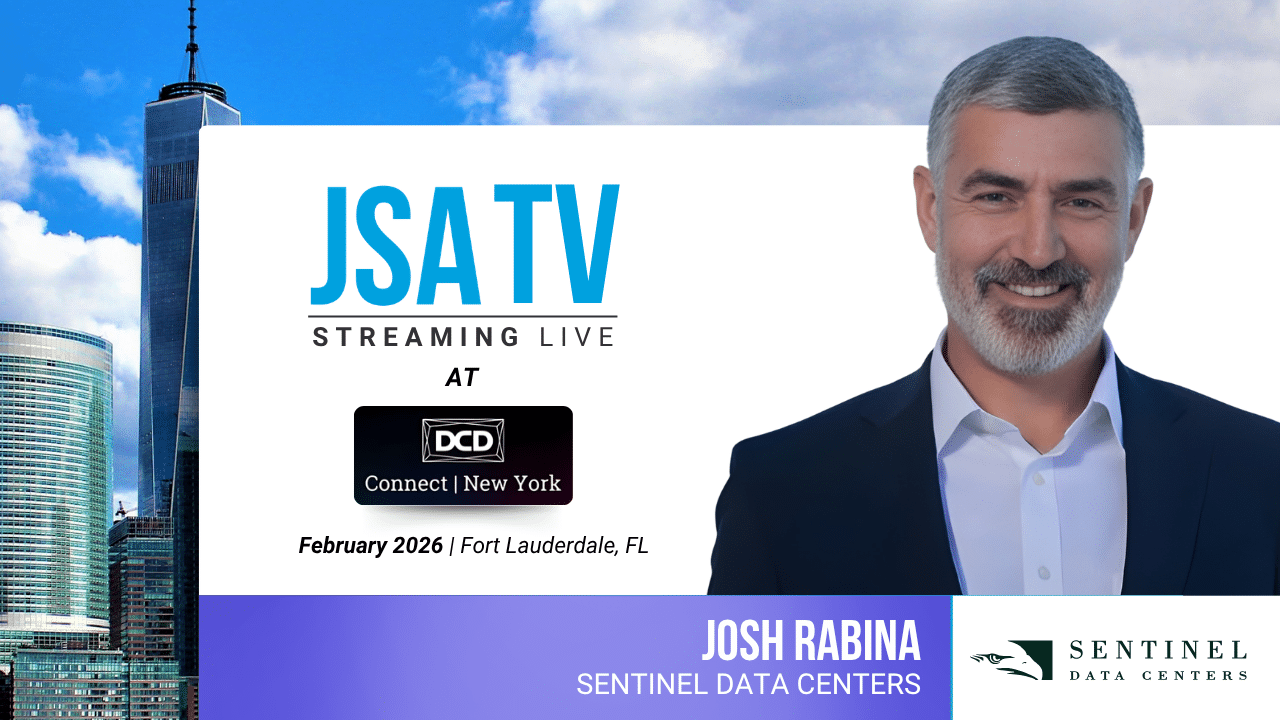
Recently, Josh Rabina, CEO of Sentinel Data Centers, sat down with JSA TV at DCD Connect in New York to discuss how the industry has shifted from simple colocation to the massive hyperscale and enterprise demands of the AI era.
Watch the full interview here: https://youtu.be/fCCrDCXwvJw?si=VJuGzRaYyuJBcPay
Resurgence of the Enterprise Data Centers
While Hyperscale and AI dominate today’s headlines, Rabina notes that the Enterprise sector such as financial services, healthcare, and pharmaceuticals still remains a cornerstone of the business.
“We cut our teeth serving the enterprise; that was the entire business when we started,” Rabina shared. “Today, while it isn’t hundreds of megawatts of AI power, it is extremely healthy. We just completed a large build-to-suit for a major financial firm in New Jersey.”
For these users, the requirements are precise and growing steadily at about 10% annually. While they are experimenting with AI, their primary focus remains on low latency and proximity to core business operations.
Scalability: From Megawatts to Gigawatts
The sheer scale of the industry has shifted dramatically since Sentinel’s inception. Rabina recalled that it took the company its first ten years to build 40 megawatts of assets, a capacity that would be considered a fraction of a single medium-sized data center today.
Sentinel’s current $6 billion pipeline is a result of long-term planning, often gestating sites for up to a decade.
The Vertical Integration Advantage
Sentinel differentiates itself through an operator-led, fully vertical model. By managing everything from land entitlement and power procurement to construction and long-term operations, they eliminate the friction that often occurs during hand-offs between developers and third-party contractors.
“Our design decisions are informed by 20 years of field experience. We don’t just build a shell and walk away; we manage the environment for the long haul,”
says Rabina. This approach ensures engineering rigor and provides tenants with a single point of accountability throughout the life of the asset.
Being A “Good Neighbor” in the AI Era
As data centers grow, so does community concern regarding noise, power prices, and water usage. Rabina argues that the industry has both a real problem and a communication problem to solve.
Sentinel addresses these concerns through responsible design:
- Zero Water Consumption: Utilizing closed-loop, non-evaporative cooling systems that act like a home AC on a massive scale, requiring only an initial fill.
- Grid Stewardship: Positioning projects to absorb transmission costs rather than passing them to local taxpayers.
- Quiet Buildings : Ensuring zero impact on the local sound environment at the property line.
- Aesthetically Pleasing Campus: Designing facilities that resemble a professional campus rather than an industrial plant with tree buffers to blend into landscape.
“It’s not salespeople that need to bridge this gap; it’s engineers,” Rabina noted. “Engineers speak truth, and the truth is that these buildings can be an asset to the economy without being a burden to the community.”
Looking Ahead
With major developments scheduled to deliver between 2026 and 2027, Sentinel is poised to continue riding the wave of the digital infrastructure boom. By blending the reliability required by the enterprise with the scale demanded by hyperscalers, they are proving that 24 years of experience is the ultimate competitive advantage.
FAQ
How does a data center benefit the local power grid?
When built at strategic positions in the grid, large-scale data centers absorb a significant portion of the fixed transmission and distribution costs. By increasing the utility’s “ratable” base, these projects can help stabilize or lower electricity rates for other residents in the long term.
Why is an “operator-led” data center model important?
An operator-led model ensures that the firm building the data center is also responsible for its long-term performance. This alignment results in better engineering choices and greater flexibility for enterprise and hyperscale tenants.
How does Sentinel address community and environmental concerns?
Sentinel utilizes engineering-driven stewardship to ensure data centers strengthen the local grid rather than strain it.
- Water Conservation: Use of closed-loop designs and free-cooling technologies eliminates water evaporation and competition for local freshwater.
- Grid Infrastructure: Sentinel ensures the developer not the taxpayer pays for the utility upgrades.
- Economic Impact: Projects deliver high tax revenue with minimal demand for municipal services like schools, roads or emergency services.